An independent, privately operated tool. Not affiliated with, endorsed by, or sponsored by the U.S. Air Force or the Department of Defense.

Regulations Guide

USAF PT Regulations Guide

Key DAFMAN 36-2905 summaries. This is not a substitute for the official Air Force document.

Summarised from DAFMAN 36-2905. The current publication is dated 24 March 2026. Page reviewed 7 September 2026.

DAFMAN 36-2905 is the Department of the Air Force manual that governs the Air Force Physical Fitness Readiness Program: who is assessed, how often, which components are assessed, what exemptions and waivers apply, and what happens after a failed assessment. It applies to the Regular Air Force, the Air Force Reserve and the Air National Guard, and does not apply to the United States Space Force, which follows SPFMAN 36-2905.

The same programme is searched for as AFI 36-2905, AFMAN 36-2905 and DAFI 36-2905; this page covers DAFMAN 36-2905. The current issue, dated 24 March 2026, supersedes DAFMAN 36-2905 of 22 April 2022.

Key Topics from DAFMAN 36-2905
Essential aspects of the Air Force Physical Fitness Program.

Testing Frequency

Physical fitness assessments (PFAs) are conducted bi-annually (twice a year) for all Airmen under the current AFMAN 36-2905. Frequency may still vary based on factors such as commander discretion or specific program requirements (e.g., retraining, PME).

Members who fail an assessment or do not meet standards will be retested more frequently, typically within 90 days, and may be enrolled in a Fitness Improvement Program (FIP).

PT Test Exemptions and Waivers

Exemptions from some or all components of the PT test may be granted for medical reasons or other specific circumstances. These exemptions must be documented by a medical provider on an AF Form 469, Duty Limiting Condition Report, or as otherwise specified in DAFMAN 36-2905.

Common reasons for exemptions include pregnancy/post-partum status, temporary injuries (e.g., broken bone), chronic conditions that prevent safe participation, or recent surgery.

Exemptions are component-specific. A member might be exempt from the run but still required to complete strength (e.g., push-ups, sit-ups, or alternates) and body composition components (WHtR).

Deployment-related exemptions, waivers for specific duty assignments, and other special circumstances are also outlined in the regulation. It is crucial to understand that an exemption for one component does not automatically exempt a member from the entire test or other components unless specified.

Our Air Force PT Calculator can help estimate scores even with some component exemptions by focusing on achieved scores for non-exempt components.

Consequences of Failure

Failing to meet PT standards can have significant career implications. Consequences escalate with repeated failures and are taken seriously by the Air Force.

  • First Failure: Member is typically enrolled in a formal Fitness Improvement Program (FIP), receives counseling, and must retest within 90 days (or as directed). A derogatory administrative action (e.g., Letter of Counseling) may be issued.
  • Second Consecutive Failure: More severe administrative actions, such as a Letter of Reprimand (LOR), may be taken. Continued enrollment in FIP.
  • Multiple Failures: Can lead to an Unfavorable InformationFile (UIF), referral Enlisted Performance Report (EPR) or Officer Performance Report (OPR), denial of reenlistment, or administrative separation proceedings.

It is crucial for members to take the PT program seriously, proactively manage their fitness, and understand the implications of not meeting standards.

Scoring and Categories

The PT test is scored out of 100 points, composed of:

  • Cardio: Up to 50 points (2-mile run or HAMR shuttle run, scored; 2-km walk is an approved alternate but is pass/fail and carries no points).
  • Strength: Up to 15 points (push-ups or hand-release push-ups).
  • Core: Up to 15 points (sit-ups, cross-leg reverse crunches, or forearm plank).

Body Composition: Assessed via Waist-to-Height Ratio (WHtR), worth up to 20 of the 100 composite points on its own scale - full points at a ratio of 0.49 or lower, tapering to zero at 0.60 or higher. It has no minimum of its own and is not a pass/fail gate; it only affects the composite total.

Overall Categories (based on meeting the cardio, strength, and core minimums):

  • Excellent: Composite score ≥ 90.0.
  • Satisfactory: Composite score 75.0 - 89.9.
  • Unsatisfactory: Composite score < 75.0, OR the cardio, strength, or core minimum not met.

Alternate Components

To accommodate members with medical restrictions documented on an AF Form 469, DAFMAN 36-2905 includes provisions for alternate aerobic and strength exercises. These exercises have their own scoring standards and are designed to assess similar fitness domains.

Common Alternate Aerobic Components:

  • 2-kilometer Walk
  • High Aerobic Multi-shuttle Run (HAMR)

Common Alternate Strength Components:

  • Hand-Release Push-ups
  • Cross-Leg Reverse Crunches
  • Forearm Plank

Eligibility for alternate components is determined by a medical provider. Using an alternate component may affect maximum achievable scores in some cases; refer to official scoring charts.

For the scoring detail behind these summaries, see the Air Force PT standards by age and gender and the Air Force PT test chart.
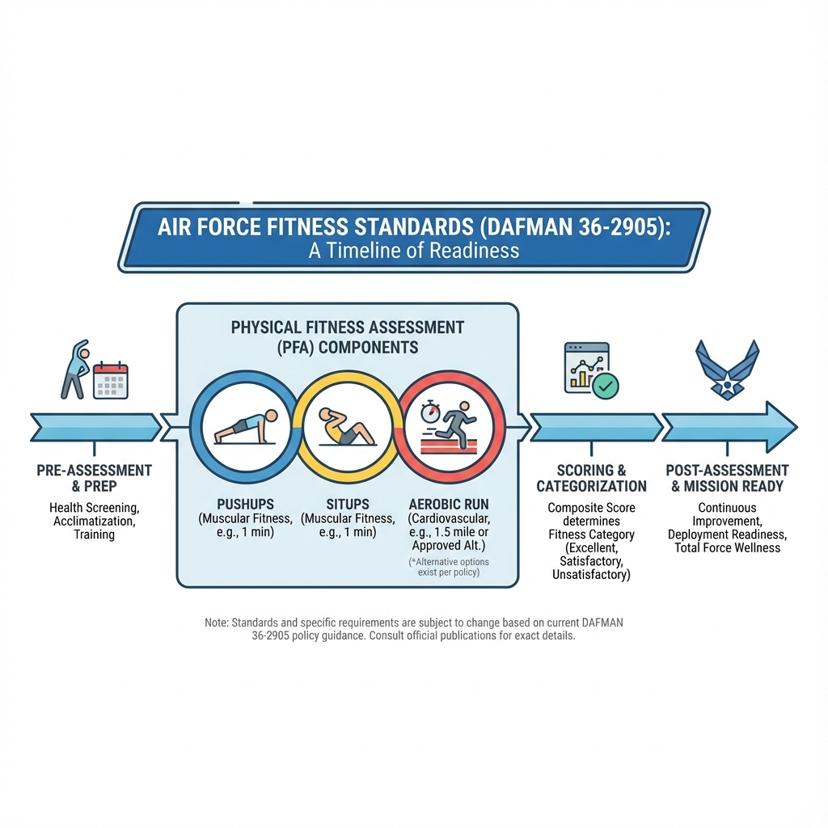
DAFMAN 36-2905 Regulations Infographic Summary

Understanding the Air Force Physical Fitness Assessment (PFA) Program is crucial for all Airmen. This guide summarizes key sections of DAFMAN 36-2905 to help you stay informed. You can use our Air Force PT Calculator to see how these regulations might impact your score calculations.